
Identify Who Owns an Evans County Property
Two Evans County custodians hold the answer. The Tax Assessor keeps the administrative owner tied to each parcel on the tax roll. The Clerk of Superior Court keeps the recorded instrument. It may be a deed, and it conveyed the land in the first place. Write the parcel number, legal description, and date next to every name you collect. Similar names cause false matches otherwise.
- Enter the location address in the official Evans qPublic parcel search.
- Copy the owner name, full map-and-parcel key, situs, and legal clues shown on the matching card.
- Search that owner as grantee in the GSCCCA Evans real-estate index and locate the newest deed for the same land.
- Compare recording date, grantor, legal description, book/page, and any later transfer before deciding who owns it.
This route identifies the owner of record in public records. It does not reveal who occupies a building. Nor does it replace a full title examination.
Start the Evans County Property Owner Route at qPublic
The Evans County Schneider qPublic application offers a property search by owner name, location address, parcel number, and legal information. The county publishes no schedule for refreshing the site. Field labels, panel order, and map tools may change, so trust what the live record displays.
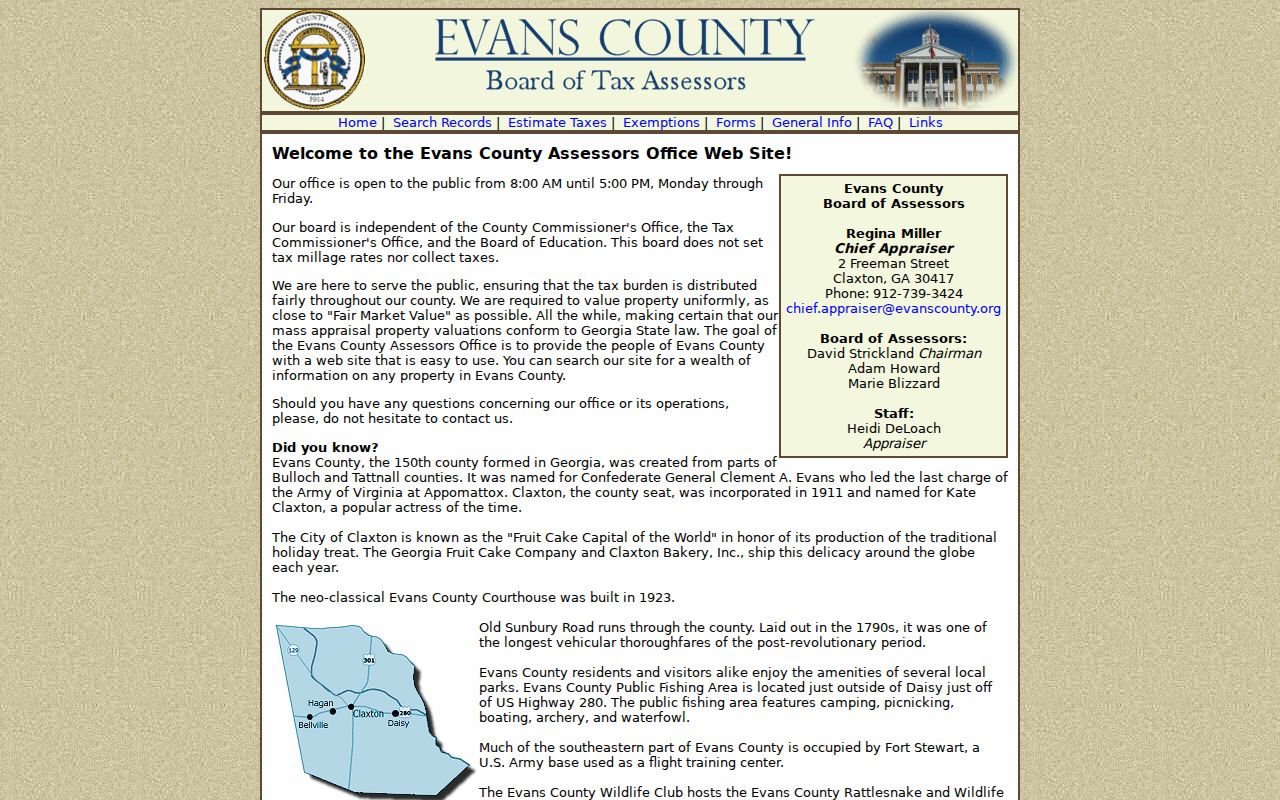
The assessor's qPublic page is the identification source. Work from what the live record shows, copy the details exactly, and date your result. If an address search fails, try the full parcel number or a legal description clue. Rural Evans County entries include zero-number addresses on Hillside Drive and Pine Drive. There, map-and-parcel, lot, phase, acreage, and plat book and page are stronger keys than any house number.
Note: Evans County publishes no verified deed-to-roll lag. Never assume a fixed update interval for qPublic.
Where Evans County Property Ownership Appears
Each source answers a different piece of the ownership question. The name on the tax roll serves assessment administration. The grantee on the latest matching deed shows the recorded conveyance. Entity filings explain a company name. The parcel map ties the tract to the right record.
| Where ownership is shown | What it contributes | How current to treat it |
|---|---|---|
| Tax Assessor roll | Administrative owner name, parcel, mailing and situs clues where displayed | Date the result and check a recent transfer |
| Clerk / GSCCCA deed index | Latest grantee, grantor, instrument type, date, and recorded reference | Use the newest matching conveyance |
| Secretary of State eCorp | Entity identity and registered-agent or filing clues | Current filing status does not itself prove land ownership |
| qPublic map | Parcel location and identifier | Reference geography, not title proof |
The owner mailing address is where the tax bill and assessment letters go. The situs is simply where the land sits. The two can differ without any error. Neither one proves who occupies the building.
Trace the Evans County Owner Name to the Latest Deed
Open the GSCCCA real-estate name search. Select Evans County, enter the assessor owner as grantee, and set a sensible date range. The index narrows further by instrument type and displays county good-from and good-through dates. Always match the legal description or recorded reference. A name alone is not enough.
The county-specific index reports a January 1, 1915 start for Evans County deed records. Search results and deed images are separate services, and account or image charges may apply. The Clerk directory states that staff will not run phone-in or write-in searches, so the practical fallbacks are the online index, a GSCCCA account, or an in-person counter search at 123 W Main Street in Claxton.
LLCs, Trusts, and Estates Can Be the Evans County Owner
When qPublic lists a company, search the Georgia Secretary of State eCorp system. That separates the entity from its name-alikes and surfaces public filing clues. A registered agent is a contact point, not proof that the agent owns the parcel. Keep the exact company name and control details beside the deed's grantee line.
Trusts and estates call for different deed records. GSCCCA instrument types worth searching include deed from estate and estate documentation. Also check trustee's deed, court order, foreclosure deed, sheriff's deed, and tax-sale deed. A Probate Court file may explain authority. But the deed recorded with the Clerk remains the confirmation step for the land record.
- Owner of record
- The name an official roll associates with the parcel at the time viewed.
- Grantee
- The party receiving the interest stated in a recorded deed.
- Title
- The legal ownership interest, which cannot be certified by a simple index result.
- Situs and mailing address
- The property location and the separate address used for official correspondence.
A Recent Evans County Closing Needs a Date Check
Evans County sources set a January 1 valuation date. They publish no typical gap between deed recording and an assessor-card update. When the roll and a recent deed disagree, compare dates and the legal description. The newest recorded conveyance is the stronger current clue. The assessor name may still reflect the prior administrative record.
The GSCCCA county coverage page reports how far behind the index sits, so date that status yourself rather than assuming every instrument appears at once. For a fuller present-owner check, see the Evans County current owner page.
Use Evans County Office Channels When the Portal Fails
The Evans Tax Assessor sits at 2 Freeman Street in Claxton. Office hours are 8 a.m. to 5 p.m. Monday through Friday, at (912) 739-3424. Ask for a parcel or assessment record by address and map-and-parcel number. The Clerk counter covers the recorded deed and plat side of the search.
A targeted request under the Georgia Open Records Act should name the custodian, parcel, record type, date range, and preferred format. The law does not oblige an office to build a title report. It will not answer a research question for you either.
Limits on Who Owns This Property in Evans County
An assessor name alone proves nothing about title. It cannot reveal every lien, easement, or encumbrance. It also cannot tell you who lives at the situs. A deed conveys only the interest the grantor held. Later releases, court orders, estate papers, boundary agreements, and liens may change the full picture.
Georgia's VoteSafe and designated-address protections also demand care. A protected mailing address must not be republished as an ordinary location clue. Owner records serve lawful property diligence, estate research, and boundary questions. They also support a good-faith attempt to contact an owner.
Owner name is not title proof. An Evans County roll may lag, and land may be held by an LLC, trust, estate, or several parties. Never use owner data to harass or target anyone.
Test an Evans County Property Owner Answer
Test any ownership answer three ways. First, the parcel identity must match. Compare the full map-and-parcel number, situs, acreage, lot or phase, and any plat reference. Evans County records show why this matters. Lettered prefixes and leading zeroes carry meaning. A rural tract may appear with a zero house number. A similar road name alone never links an assessor card to a deed.
Second, the instrument must truly convey an interest. GSCCCA indexes warranty, quitclaim, gift, estate, foreclosure, sheriff's, trustee's, and tax-sale deeds. Security deeds, liens, releases, easements, court orders, and powers of attorney sit alongside them. Those records can affect the property without naming any new owner. Read the instrument type and each party's role. Do this before treating the latest date as a transfer.
Third, the timeline has to make sense. The assessor offers an administrative owner clue. The deed index supplies a recording date. The Evans good-through page shows the index's status when viewed. Save all three dates. If the card and deed disagree, report the difference rather than picking the answer you prefer without support.
This check matters most after an estate, foreclosure, or tax sale. Probate may establish an administrator's authority. The deed records the conveyance itself. A tax-sale deed may need redemption research later. Asking who owns the property is thus distinct. It differs from asking whether liens, security interests, easements, or court claims remain.
An office inquiry needs specifics. Give the Evans County Clerk the party name, parcel and legal description, date span, and any known book/page or instrument number. The official Clerk listing says the office will not run phone-in or write-in searches. So a counter visit or the GSCCCA system is the verified route. A narrow Open Records request may seek an existing record. The custodian need not create an ownership report, however.