
Build an Evans County Former-Owner Timeline
The core of the work is a backward transfer table. Start with the current deed, then work rearward. Add a row each time a grantor turns up in an earlier acquisition deed. Gaps and non-sale transfers belong in the record too. Note them rather than forcing the chain into a tidy sequence.
| Transfer date | Grantor to grantee | Deed type | Book/page or instrument |
|---|---|---|---|
| Newest matching recording | Prior holder to current grantee | Copy the indexed instrument type | Record the exact citation |
| Earlier acquisition | Earlier owner to the prior holder | Warranty, quitclaim, gift, estate, or other type | Use the citation from that deed |
| Chain interruption | Estate, sheriff, trustee, or court-related parties | Record the actual nonstandard transfer | Cross-check related files |
| Pre-1915 branch | Owner names found in older index or book | Do not assume the transfer type | Clerk or predecessor-county citation |
Only add a row when the legal description or plat evidence ties the transfer to that same land. A former-owner timeline is an audit trail. It is not a list of people who happen to share a name.
January 1, 1915 Sets Evans County's Online Boundary
The GSCCCA Evans coverage page states one clear fact. The county real-estate index starts on January 1, 1915. A Clerk notice echoes that date. It says deeds and plats from 1915 forward can be viewed or purchased through GSCCCA. Treat 1915 as a routing point. It does not mean older records disappeared.
Evans County was created in 1914 out of land taken from Bulloch and Tattnall counties. A chain reaching past the county's founding may require extra digging. That work happens in a predecessor county's deed records. The sources publish no map of where the older books now sit. So ask the Clerk or the Georgia Archives before deciding which volume to search.
Online cutoff. The Evans County online deed index begins in 1915. Continue through Clerk-held books, indexes, archives, and predecessor counties for earlier former owners.
Walk the Evans County Deed Chain in Reverse
The GSCCCA name search lets you filter by party type, instrument type, county, and date range, with result counts and display controls. Run it for Evans County using the grantee role. That shows how each prior owner first picked up the parcel.
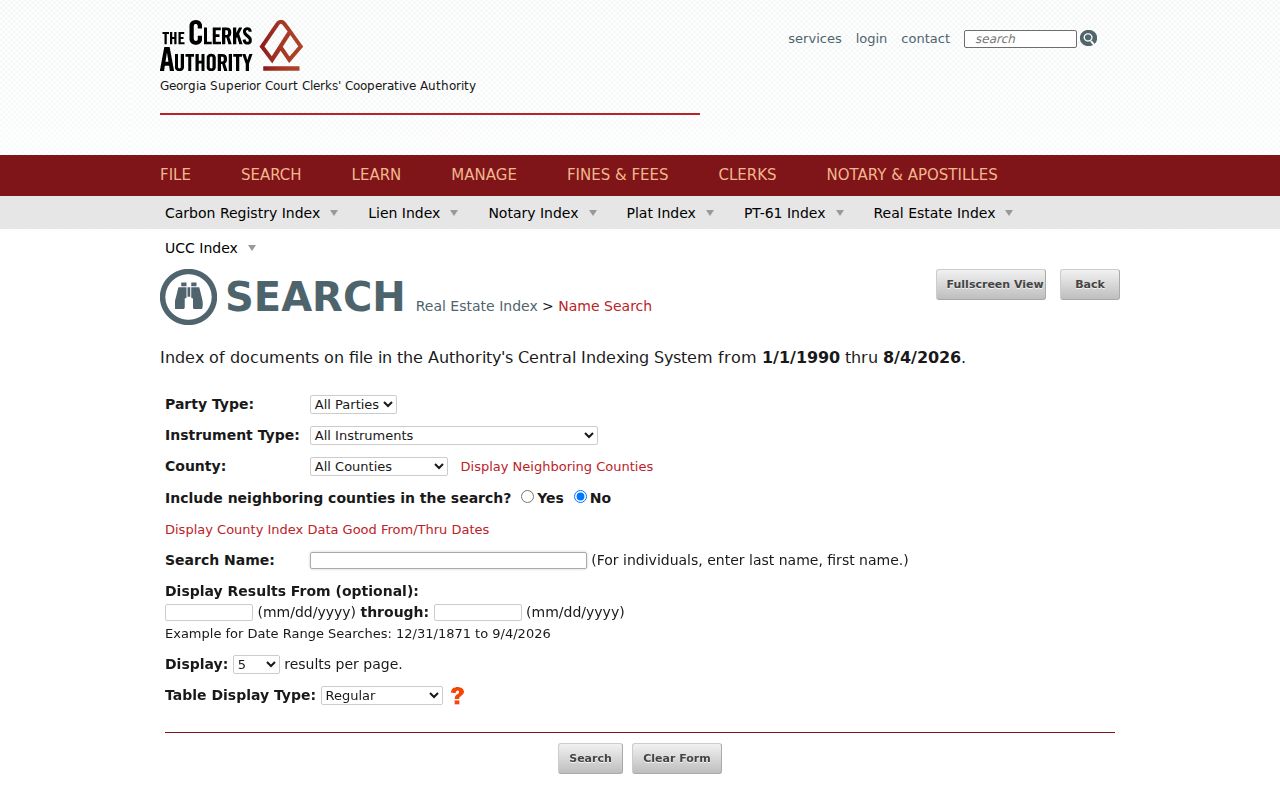
The official search form displays the party, instrument, county, and date controls you will use to step from one owner to the next.
- Find the latest deed for the parcel and read the grantor who conveyed it.
- Search that grantor as a grantee in an earlier date range.
- Match the legal description, subdivision and lot, acreage, plat, or book/page before accepting the result.
- Repeat until the chain reaches 1915 or an instrument that requires a court, probate, or tax-sale cross-check.
- Grantor and grantee
- The party conveying an interest and the party receiving it.
- Chain of title
- The ordered sequence of recorded transfers tied to the same land.
- Reverse index
- The grantor-side route used to follow conveyances backward.
- Warranty and quitclaim deed
- Different conveyance forms whose legal effect cannot be judged from the index label alone.
Evans County Book and Plat Citations Hold the Chain Together
Street addresses shift or come up blank. An official Evans County document shows why legal keys are sturdier. One entry there tied map-and-parcel H04 009 to a zero-number Pine Drive address. The same entry carried Groveland Heights Lot 1B, Plat Book 2/Page 157, and Deed Book 194/307-308. Another entry linked 040C 007 to 242 Lotts Road. It also cited Plat Book 11/Page 237 and Deed Book 309/432-433.
Those citations are historical leads drawn from a county tax-property document. They are not current ownership statements. Still, they illustrate what a former-owner search should capture at every step. That list covers the parcel key, lot and phase, acreage, plat citation, and deed citation.
Note: A zero-number road address is a reason to lean on legal keys, not a reason to discard the Evans County parcel.
Estate and Forced-Sale Deeds Change the Evans County Trail
A tidy grantor-to-grantee chain can snap when land moves through an estate, foreclosure, tax sale, sheriff's deed, trustee's deed, court order, or deed of gift. The GSCCCA instrument menu flags all of these. It also lists quitclaim, security deed, lien, release, easement, right-of-way, and boundary-line agreement types.
When an estate surfaces, pull the Evans County Probate Court file to confirm the executor or administrator's authority. Then step back to the recorded deed. For a forced sale, record the prior owner, the sale instrument, any redemption or release clue, and the later conveyance. Not every transfer is an ordinary sale.
Continue Evans County Former-Owner Research Offline
The Evans County Clerk of Superior Court sits at 123 W Main Street in Claxton. The office holds the county's real-estate instruments and plats. The official directory notes that staff will not run phone-in or write-in searches. For records without an online image, visit the counter with your book and page numbers. Ask directly about older indexes, bound volumes, or microfilm.
The Georgia Archives offers a catalog and finding aids. Its Virtual Vault holds historical county and land material. No courthouse fire or lost-decade story appears in any sourced account of Evans County. Never explain a missing online result with a disaster the record does not support.
Keep Evans County Name Variants Tied to the Land
Former owners hide behind initials, married names, co-owner pairings, estate wording, trusts, and companies. For an entity, the Georgia eCorp search separates similar names and filing identities. A registered agent is a contact clue, not a former landowner, unless the deed itself says otherwise.
Narrow common names by date, instrument, and Evans County. Then insist on a match in legal description, book/page, plat, or grantor relationship. Obituaries, address directories, and occupancy history add color. None replaces the recorded conveyance.
Know Where Evans County Ownership History Stops Online
The searchable Evans index stops at 1915. Anything earlier needs a documented handoff. Ask whether the Clerk holds the older book or index, and whether the tract sat in Bulloch or Tattnall before Evans County existed. If a specific volume cannot be located, record the gap honestly.
An index chain is not a title opinion. It can miss an unindexed image, an alternate name, a probate event, a boundary agreement, or a lien. For single-instrument mechanics and copy access, use the Evans County deed records guide.
End the timeline at the last supported transfer. Cite each source. Mark the next research branch instead of guessing an owner for an uncertain year.
Historical research has limits. Use former-owner records for house history, estate work, and land diligence. Never use the chain to track, intimidate, or harass a living person.
Bridge Old Evans County Descriptions to the Present Parcel
A backward chain eventually hits a deed with no usable modern street address. That is the moment to stop searching by address and start reading the land vocabulary inside the documents. Keep every clue the deed offers. That includes Georgia Militia District or land lot, metes-and-bounds courses and distances, adjoining owners, road names, acreage, subdivision lot, phase, and plat book and page. Together those details show whether an older deed and today's tax parcel cover the same ground.
Historic road names deserve special care. Evans County assessor history identifies Old Sunbury Road as a route laid out in the 1790s. A deed citing that old road cannot be matched to a current address by text alone. Compare plats, later deeds, county mapping clues, and archival maps. If the evidence only hints at a match, treat it as a lead. Do not place the named party on the confirmed former-owner timeline on that basis.
The 1914 creation of Evans County raises another bridge problem. Land that later fell inside Evans may have been recorded in Bulloch or Tattnall first. That could predate the new county's books. No parcel-by-parcel predecessor-book map exists for this situation. Start with the last supported Evans deed. Ask the Clerk what prior citation it recites, and check Georgia Archives finding aids before searching a predecessor county.
Plats preserve continuity when names or road descriptions shift. The GSCCCA plat search accepts county, name, plat type, date, GMD or district, and land-lot controls. A recorded plat can tie a modern lot to an earlier parent tract. A tax polygon alone cannot establish that genealogy. Record every split, recombination, or phase change the documents support.
Negative findings belong in the chain too. A missing online image does not prove a deed never existed. No sourced Evans County courthouse fire explains any gap. Write down which index, date span, spellings, instrument types, and book ranges were covered. That record lets the next search pick up at the Clerk counter or an archive. It spares you from repeating unsupported assumptions.