
Fields Across Evans County Property Tax Records
Two Evans County offices divide the work. The Tax Assessor sets value and takes exemption applications. The Tax Commissioner handles the tax bill, collection, and delinquency questions.
| Field | What It Shows | Where |
|---|---|---|
| Fair-market value | January 1 estimate under Georgia rules | Tax Assessor |
| Assessed value | Forty percent of fair-market value | Tax Assessor |
| Exemptions | Approved homestead, age, veteran, conservation, or other treatment | Tax Assessor |
| Bill and payment | Amount billed, collected, or delinquent | Tax Commissioner |
| Tax-sale deed | Recorded sale and later redemption or release clues | Clerk and GSCCCA |
An assessed value is not a sale-price opinion. Neither is the bill. Exemptions change taxable treatment, while a deed or PT-61 filing offers its own separate clue about a transaction.
January 1 Values in Evans County
Georgia's framework fixes fair-market value as of January 1 and uses a 40 percent assessed level. One mill is one dollar of tax for each one thousand dollars of taxable value. These rules explain the framework, not a parcel's exemptions or districts.
The Evans Assessor information page gives the local explanation.
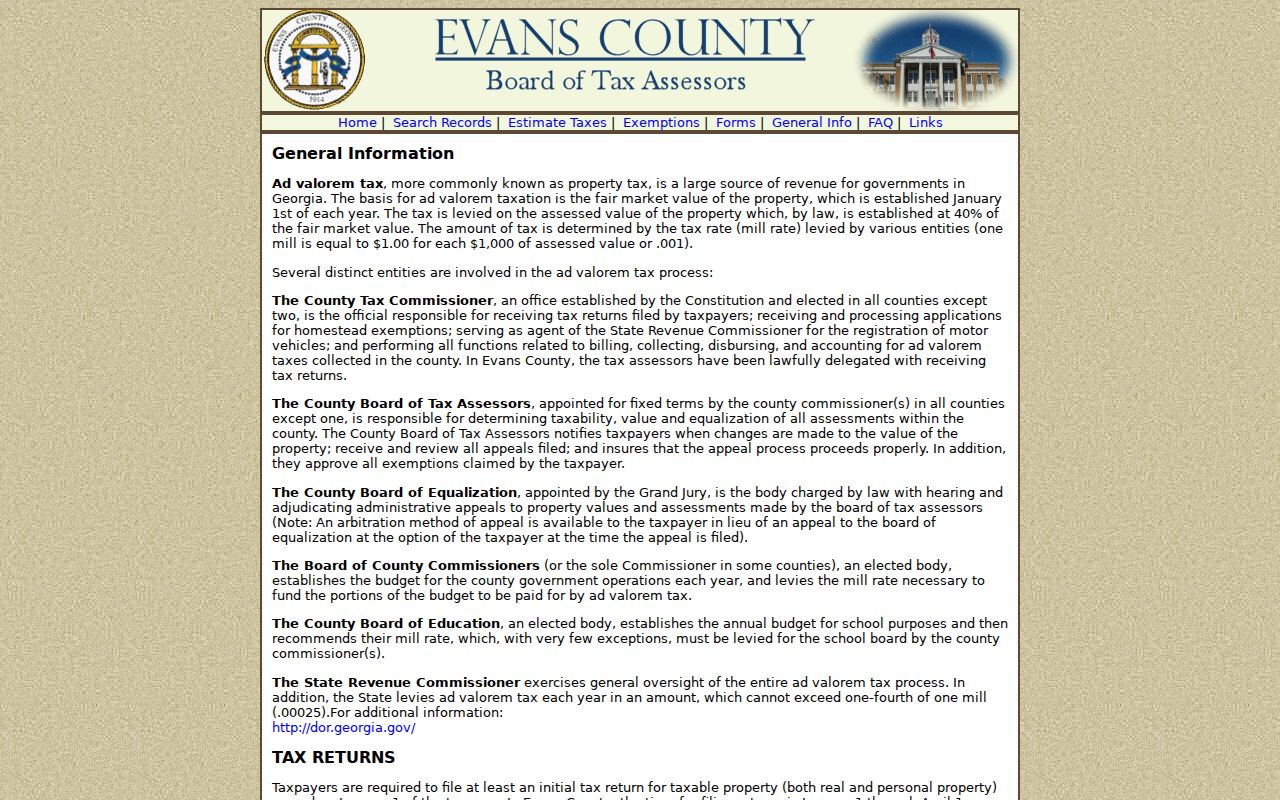
Pair this framework with the parcel's dated notice and the Tax Commissioner's current bill.
Evans Homestead and Senior Exemptions
Evans County offers several relief routes. County materials describe a standard homestead exemption, over-65 and over-62 school options, disabled-veteran and surviving-spouse programs, and deferral. Eligibility rules differ, so file the current application and confirm the deadline and proof each program wants. The Evans exemption page lists these categories.
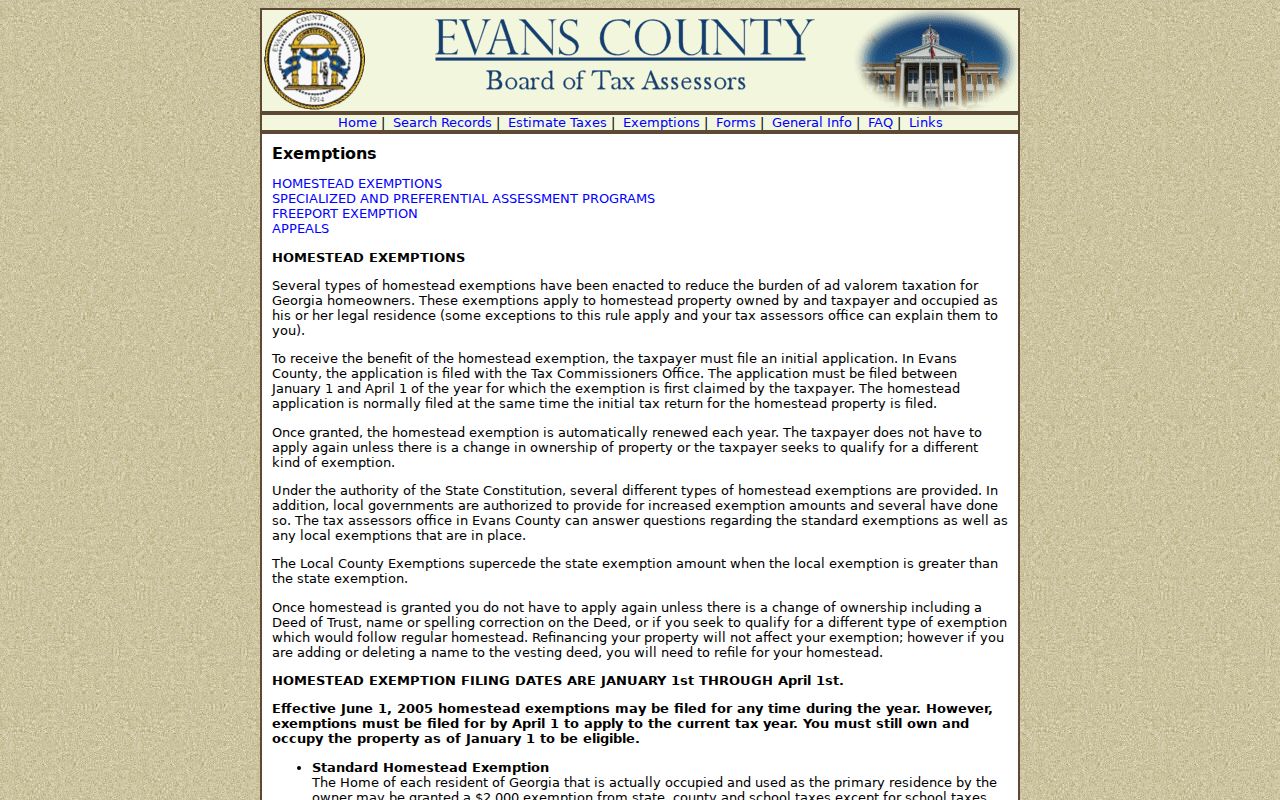
An exemption explains a parcel's taxable value, yet it is limited evidence and proves nothing about title.
Evans Conservation and Freeport Forms
Conservation use can carry a ten-year covenant and a statewide 2,000-acre cap, with real consequences for breach. Freeport requires its own annual filing. Neither status follows automatically from how a parcel looks on a map. Use the Evans forms page for current documents.
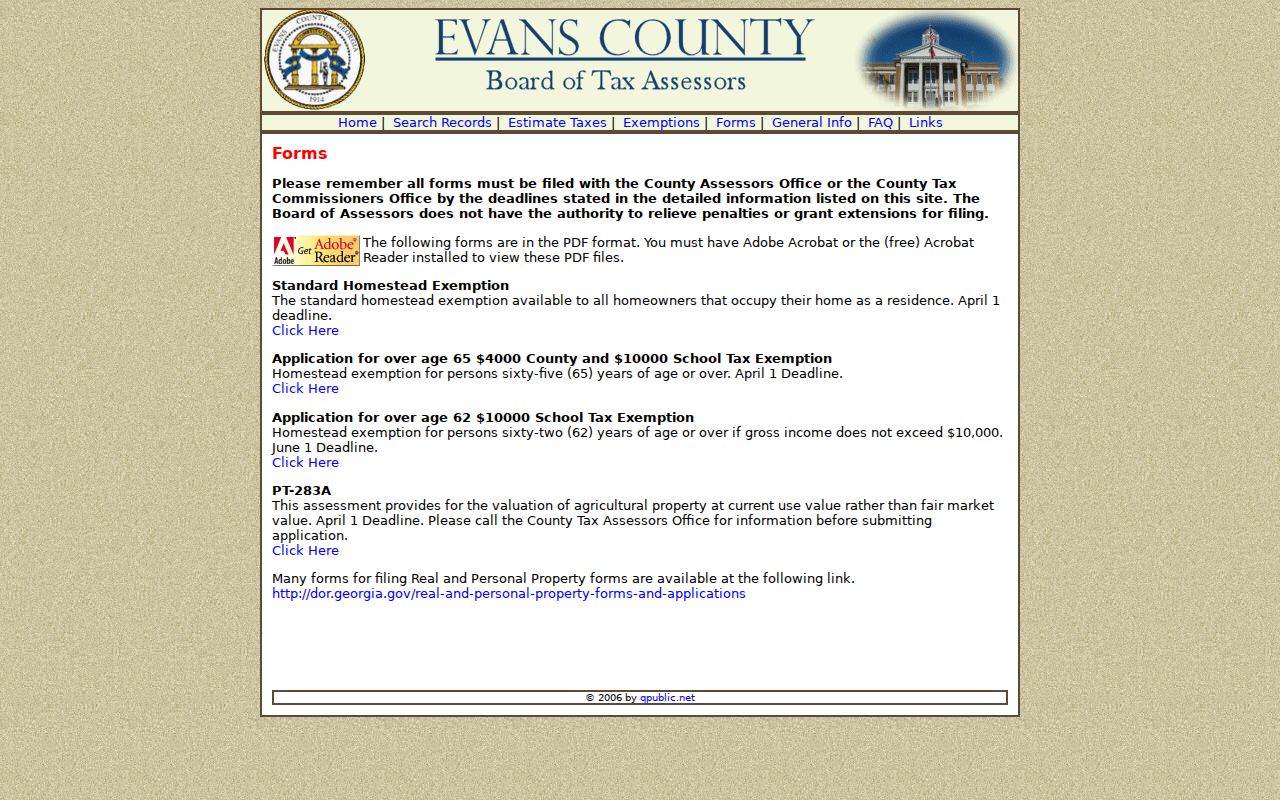
The Assessor should confirm which form and evidence fit the parcel and year.
Look Up an Evans County Tax Bill
Evans County publishes no public bill portal. Identify the parcel first in qPublic. Then contact the Tax Commissioner with the exact map-and-parcel number and tax year in hand. An assessor card alone never proves a bill was paid.
- Search qPublic by address, owner, parcel, or legal information and copy the parcel key.
- Ask the Tax Commissioner for the existing bill, balance, payment status, and available prior-year record.
- Compare the Assessor's value and exemption record for the same year.
- If delinquency or sale appears, search the Clerk's deed and release trail.
- Assessed value
- Forty percent of fair-market value in the verified Georgia framework.
- Mill
- One dollar per one thousand dollars of taxable value.
- Homestead exemption
- Approved treatment tied to statutory eligibility and application.
- Tax lien
- A claim for unpaid tax that needs current record and release review.
The Evans Tax Commissioner Holds Bill Status
The Tax Commissioner sits at 201 Freeman Street, Suite 4, in Claxton. The county publishes (912) 739-1147 and ectc@evanscounty.org for the office. The official Tax Commissioner page is the reliable route.
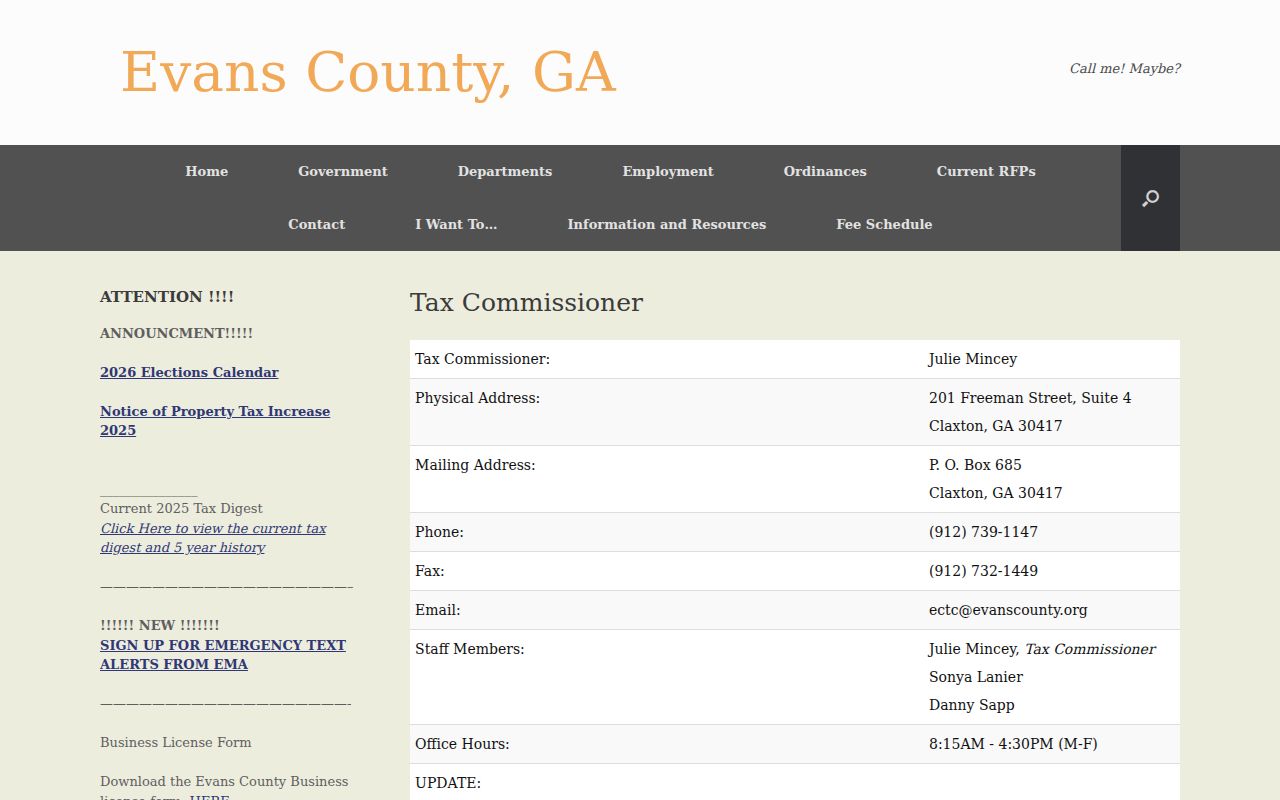
Use the county-published number instead of contact details on an unverified delinquency notice.
Evans Digest Changes Are Aggregate
The total Evans County digest jumped between 2023 and 2024, then declined in 2025. Those are countywide movements. They do not prove a revaluation occurred or show what happened to any single parcel. Compare a parcel's own notices by date. Then sort land, improvement, exemption, and ownership changes into separate columns. An aggregate line is never a parcel trend.
Tax-Sale Deeds Need a Second Record Check
A delinquent account and a recorded tax-sale deed answer different questions. Evans deed records cite parcel numbers alongside tax-deed book and page references, which builds a bridge from the tax roll to the Clerk's office. Pull the sale deed, any redemption, releases, later deeds, liens, and court context before drawing conclusions. A tax deed alone is not clean title.
Assessor and Commissioner Roles Do Not Merge
The Board of Tax Assessors establishes value. Its staff maintain the assessment roll and administer exemptions. The Tax Commissioner then bills and collects based on that work. A value dispute starts with the assessment notice and its appeal route. A balance or receipt question starts with the Commissioner. The split matters most when records disagree. A corrected mailing address in one system does not update the other. Give each office the parcel key, tax year, and document at issue. Then ask for the correction procedure within that office's authority.
Owner, Mailing Address, and Homestead Clues
The owner name and mailing address on a tax roll are administrative clues, nothing more. That mailing address may point to a nonresident owner, a trust, an entity, or a tax contact. It is not the parcel's situs. An exemption flag helps with a tax question. But it cannot replace the latest recorded deed or show who lives there today. After a recent sale, compare the dated assessment record against the newest recorded grantee deed. Evans County publishes no official interval for rolling a new deed into the tax roll. So never promise a set number of days. Note the date on each record and let the two sources speak for themselves.
Keep Evans Tax Years Separate
Tax records only mean something when the year is explicit. Fair-market value reflects a January 1 snapshot. An exemption applies under that year's rules. A bill can shift from unpaid to paid to delinquent. A current portal view should never quietly overwrite what an older notice said. Build a small worksheet for each parcel. List the year, fair-market value, assessed value, exemption, taxable value, bill amount, status, and source date. Laid side by side, those lines show whether the problem is valuation, eligibility, billing, or a simple record mismatch. A countywide digest trend is never the parcel's own history.
Evidence for an Evans Assessment Review
A winning review leans on the county's own parcel facts. Pull the land size, classification, situs, legal description, and improvement details first. Get those facts from the property records. Then match each point to a document that speaks to it directly. Photographs capture condition at the relevant time. A survey settles disputed dimensions. Comparable parcel records test whether similar land is valued evenly. A qualified appraisal offers an independent opinion of value. Date every item and tie it to the appealed year so the evidence stays clean.
Keep a title dispute out of a valuation appeal unless you explain the record error clearly. Alternatively, spell out the record error before raising title at all. Wrong owner of record or acreage? Supply the deed, plat, or survey reference that proves the correction. When the math on the tax bill is the real problem, slow down before you file anything. Figure out whether the disputed figure came from the assessor. It may instead have come from billing and collection.
Delinquency Notices Need Official Verification
A mailed demand can quote real owner and parcel data straight from the tax roll. It can still be a fake. Verify it. Call the Tax Commissioner using the number Evans County publishes. Never use the one printed on the demand itself. Ask for the parcel number, tax year, balance, penalties, status, and any sale record already on file. Write down the date of the staff response and keep whatever official document they provide.
If a tax sale or deed has been recorded, carry its book and page citation to the Clerk. Search the later instruments, not just the sale document. Redemption language and releases can change everything. Never sign a quitclaim deed, power of attorney, or rescue agreement. Do not do it just because a letter asked you to. When deadlines or rights are at stake, get qualified Georgia advice.
Note: Label every Tax Commissioner payment answer and every Assessor value answer by office, parcel, tax year, and access date.
Follow Evans Property Tax Forms to the Current Version
Deadlines and proof rules shift over time. Start with the county's live forms page and the date printed on the assessment notice. Save a copy of whatever you file, and get delivery or receipt evidence too. For an exemption issue, name the specific program. Do not ask for all relief at once. Homestead, senior, veteran, conservation-use, Freeport, and deferral rules each serve different claims.
The form alone is not the whole record. Pair it with the notice, your supporting proof, the parcel key, and any office response. That packet reads far better in a later review. An undated portal printout never could.
Challenge an Evans County Assessment
An appeal targets value, uniformity, taxability, or exemption treatment. It is not a complaint about the tax bill in general. The deadline is 45 days after the assessment notice, so preserve your delivery proof.
Strong evidence includes the notice itself and parcel facts. Add comparable property records and photographs. A survey or appraisal helps, and documentation of the specific error matters too.
The route may run through the Board of Equalization. Arbitration or Superior Court options exist under the applicable rules. Confirm your chosen path and the current form before filing.
Appeal window. File an Evans County assessment appeal within 45 days of the notice; the notice date starts the parcel-specific clock.
Request Missing Evans Tax Records
Request an existing record by parcel number, tax year, owner label, and bill or notice type. Add the date span. The Georgia Open Records Act requires a response or notice within three business days. It also gives the first 15 minutes of search and retrieval free. Ordinary copies are generally capped at $0.25 per page under current statutory terms. The Act stops short of obligating staff to build a tax history. It does not require them to run a hypothetical tax bill calculation or hand out legal advice. A narrow request for a bill, notice, ledger entry, delinquency record, or assessment document works far better.
Note: Tie every Evans County property tax value to its tax year and access date, because records change.