
Begin an Evans County Property Records Search
Most people begin with the Evans County qPublic application. It offers search modes by owner name, location address, parcel number, and legal information. Result labels vary. So read the live parcel card rather than assuming what a field contains. Copy the map-and-parcel number exactly, keeping every letter, space, and leading zero. The parcel card is an administrative record, not a deed. Values, mailing addresses, map lines, and indexed instruments each update on their own schedules. None of them stands in for a title opinion or a boundary survey.
- Search qPublic with the street address, owner, parcel number, or legal information available.
- Save the parcel key, owner spelling, situs, mailing address, legal description, and any deed reference shown.
- Search GSCCCA for the newest recorded conveyance and compare its legal description with the parcel card.
- Ask the Tax Commissioner for bill, payment, or delinquency records, since no local public tax-bill screen was verified.
- Use the qPublic map and recorded plat as reference, then obtain a survey when a boundary must be established.
The Offices Behind Evans County Property Records
Three Evans County offices split the land-record work. The Clerk of Superior Court records deeds, liens, plats, FiFAs, and similar instruments. The Tax Assessor maintains the parcel and value roll and administers exemptions and appeals. The Tax Commissioner bills and collects property tax. Call whichever office owns the record you need. The courthouse has no single combined records desk.
Evans County Clerk of Superior Court
123 W Main St, PO Box 845
Claxton, GA 30417
(912) 739-3868
Evans County Tax Assessor
2 Freeman Street
Claxton, GA 30417
(912) 739-3424
Evans County Tax Commissioner
201 Freeman Street, Suite 4
Claxton, GA 30417
(912) 739-1147
Evans County Deeds Start Online in 1915
Evans County deeds begin online on January 1, 1915, per the GSCCCA index. Deeds and plats from 1915 forward can be viewed or purchased through GSCCCA. A county clerk notice says the same. The county itself dates to 1914, so the index nearly spans its whole life. What it cannot settle is land history from the years before Evans existed.
A chain that ends at the start of the Evans index should branch into predecessor-county work. Evans was carved from Bulloch and Tattnall counties. An older conveyance may sit in one of those counties' books. The clerk or Georgia Archives can say where a particular early legal description belongs. No Evans office reports a fire, flood, or lost decade. An online starting date should not be mistaken for a story of destroyed records.
- Grantor
- The party conveying an interest.
- Grantee
- The party receiving the recorded interest.
- Book and page
- The citation used to retrieve a recorded deed or plat.
- Chain of title
- The linked sequence of conveyances for the same land.
Search Fields in the Evans County Deed Index
With a party name and an approximate date, the GSCCCA grantor-grantee form supports a focused Evans County property records search. It also helps separate deeds from security deeds, easements, releases, and corrective instruments. Some results and images require account access. For official in-person work, the clerk counter remains the route.
| Search control | Use in an Evans County search |
|---|---|
| Party name and role | Search a grantor, grantee, or both, including recorded name variants. |
| Instrument type | Narrow to deeds, security deeds, liens, easements, releases, or another indexed class. |
| County and dates | Select Evans and allow for a gap between execution and recording. |
| Book and page | Open a known citation with the separate book/page form. |
| Display and limit | Control the list format and number of returned rows. |
The clerk directory states that staff will not perform phone-in or written searches. Use the web index, visit the counter, or request a specifically identified record rather than asking staff to research a full title chain. The official GSCCCA name-search screen shows the statewide form used to narrow Evans filings.
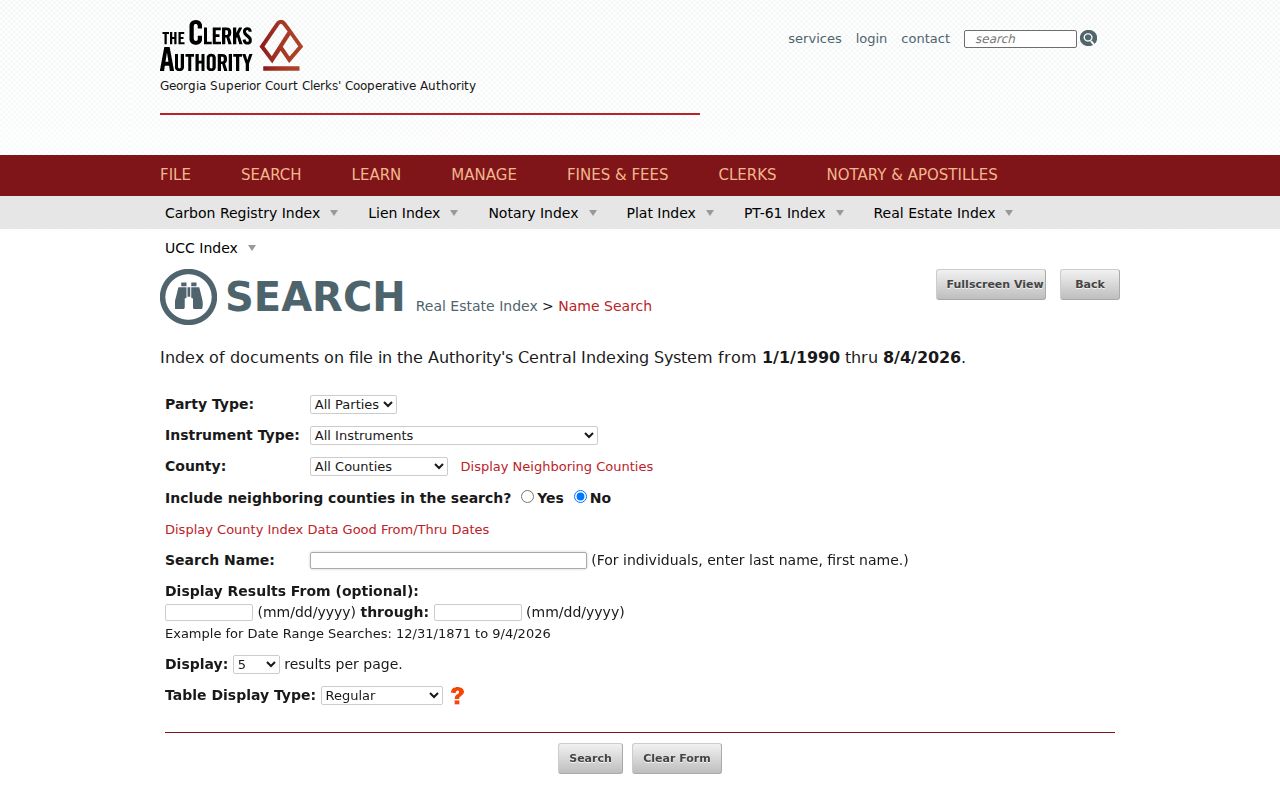
The form displays party role, instrument class, county, and date before any image is opened.
Evans County Values Use Georgia's Forty Percent Level
The Tax Assessor determines fair market value as of January 1, and Georgia property is assessed at 40 percent of fair market value. Exemptions may change the taxable amount without changing the underlying fair market estimate. The assessor does not collect the bill. Payment, delinquency, and collection questions go to the Tax Commissioner.
The official five-year history shows countywide total digest movement from 249,935,938 in 2023 to 389,500,995 in 2024, followed by 365,449,383 in 2025. Those aggregate figures provide context, not proof that one parcel changed by the same percentage. Compare the dated parcel card, annual notice, and any recorded sale for the land in question.
The Evans exemptions page covers homestead, senior, disabled-veteran, surviving-spouse, conservation-use, agricultural, and Freeport topics. Forms and eligibility must be confirmed with the assessor.
The county's general assessment guidance places valuation, the assessment level, returns, and office roles in one official source.
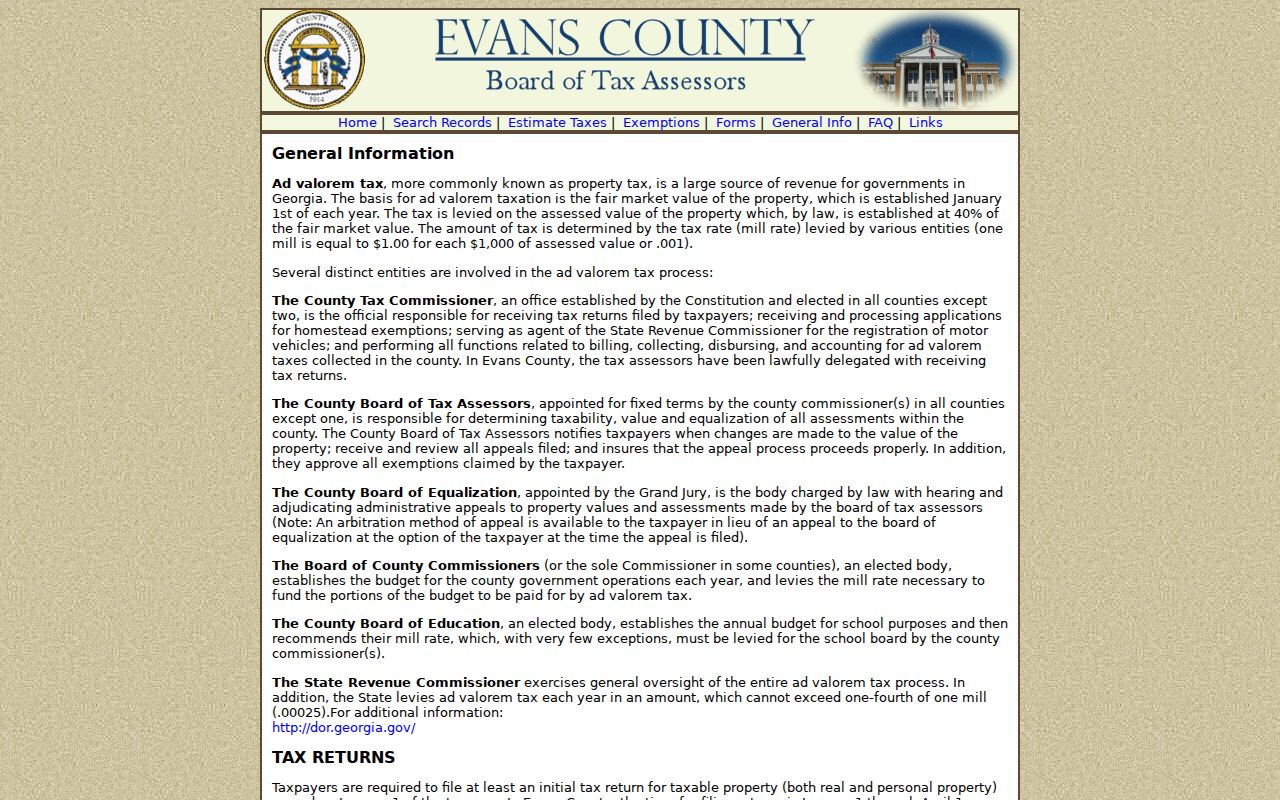
Background reading helps, but the live parcel card and its date remain the property-specific evidence of value.
Liens and Releases Change the Evans County Picture
A deed search by itself can miss recorded claims and their later cancellations. GSCCAA keeps real-estate, lien, and plat searching separate. The Clerk files deeds, liens, FiFAs, UCC work, and related instruments. A complete Evans County property records review runs the owner and any related entity name. It spans the likely instrument classes. Then it checks for releases, cancellations, assignments, corrective deeds, easements, lis pendens, and tax-sale or sheriff's deeds.
Name order matters. Individuals may appear with initials, former names, or as one of several owners. An LLC or trust must be searched under its recorded legal name. Georgia SOS eCorp can resolve a company name or registered agent. Those entity fields do not prove the company owns the parcel. For the land-specific link, return to the deed and legal description.
A security deed may reflect a loan interest. A recorded release may show the indexed claim was canceled. Neither should be judged from the first hit. Read the instrument dates, parties, cross-references, and legal description. Then check whether a later filing changes its effect.
Records That Describe Evans County Property
Evans County property records are not one master file. They form a cross-referenced set spread across several offices. A deed records a conveyance, while the parcel roll assigns each tract an administrative key and a value. The tax office tracks the bill, a plat depicts the legal division, and court or probate files can explain changes that look nothing like an ordinary sale.
| Evans record | Question it helps answer | Custodian | Verified route |
|---|---|---|---|
| Deeds | Who conveyed an interest, to whom, and by which instrument | Clerk of Superior Court | GSCCCA or clerk counter |
| Security deeds, liens, releases | Which recorded claims or cancellations affect the land | Clerk of Superior Court | GSCCCA real-estate and lien indexes |
| Assessment roll | Parcel key, owner field, value, and exemptions | Tax Assessor | qPublic or assessor counter |
| Tax bill and collection | What was billed, paid, or remains delinquent | Tax Commissioner | Counter, phone, or mail |
| Plats and parcel maps | Lot, phase, acreage, book/page, and reference geometry | Clerk and mapping support | GSCCCA plat index, qPublic, or request |
| Permits and subdivision approvals | Existing county or municipal regulatory action | County or relevant city | Ordinance pages and focused request |
A title-related case may surface in Evans Superior, State, Magistrate, or Probate Court. Georgia eAccess lists the Superior and State Courts online. When the system lacks the docket or document you need, the local clerk remains the file source.
Zero-Address Parcels Are an Evans County Clue
Some Evans parcels carry addresses like "0 Hillside Dr" or "0 Pine Dr." Those entries are not errors to discard. Rural and undeveloped land is often easier to find through a map-and-parcel search, acreage, lot and phase, plat book and page, or an owner name than through a street number.
One county entry ties parcel 016G 006 to "0 Hillside Dr," Lot 22-F Phase 12, 3.532 acres, and Plat Book 13/Page 72. Another ties H04 009 to "0 Pine Dr," Groveland Heights Lot 1B, and Plat Book 2/Page 157. These pairings come from a county RFP. They are crosswalk examples, not proof of current ownership or municipal location.
Copy the local parcel format exactly. Evans examples mix letter prefixes, spaces, and leading zeros. When an address fails, a precise book-and-page citation gives the clerk a much stronger retrieval key for pulling the plat or deed records you need.
Evans County Plats Need Approval Before Filing
Evans County plats need approval before filing. The subdivision ordinance requires a Board of Commissioners approval stamp on any plat headed for recording. Its rules also set standards for minor subdivisions. Lots need at least 125 feet of public-road frontage. Front setbacks must be 25 feet, and side and rear setbacks must be 15 feet. Access must be consistent with Georgia Department of Transportation guidance.
A recorded plat may show lots, dimensions, roads, easements, and a book/page reference. It does not establish current zoning compliance. Nor does it settle a boundary in the field. Use the GSCCCA plat index or the clerk for the recorded image. Evans Technical Services handles GIS support requests.
The GSCCCA subdivision and property search does not list Evans as a participating county. If a name search fails, work from a known plat book and page. You can also try a party name, GMD or district, land lot, and date range. The clerk can also pull a specifically cited plat on request.
Four Evans County Cities Supply Postal Clues
Four incorporated municipalities sit inside Evans County. The official material assigns ZIP 30417 to Claxton, 30429 to Hagan, 30414 to Bellville, and 30423 to Daisy. A postal city helps normalize an address for an Evans County property search, but it settles nothing about incorporated limits, tax district, zoning, or which office holds the deed.
Incorporation dates add useful history. Claxton dates to 1911, Hagan to 1906, and Bellville to 1959. That matters when an old instrument names a town that predates the county itself. The deed and assessment system, though, stays county-held no matter which municipality a parcel sits near.
Postal label
Useful for mailing, address variants, and narrowing a qPublic query.
Legal location
Requires the parcel, legal description, boundary evidence, and the relevant tax or ordinance record.
Offline Evans County Requests Fill Portal Gaps
Portals do not cover every need. The qPublic application restricts direct viewing. The county publishes no public tax-bill search. It offers no parcel-data download and no city permit database. Counter, phone, mail, and open-records channels are therefore part of the normal path for Evans County property records.
Georgia's Open Records Act, O.C.G.A. §§50-18-70 et seq., guarantees access to existing public records. The agency generally must produce the record within three business days. It may instead give the required response notice in that window. The first 15 minutes of search and retrieval time are free. Reasonable labor may be charged after that. Copies generally may cost up to $0.25 per page under §50-18-71.
Address a narrow request to the proper custodian. Include the address, parcel number, party name, record type, date span, and preferred format. The Act does not require an office to create a new map layer. It does not have to perform title research or answer a legal question.
Evans Courts and Probate Complete Some Trails
Some ownership changes never start with a normal sale. Probate files can name an estate, an executor, heirs, or the authority behind an executor's deed. Superior Court records may hold quiet-title orders, lien rulings, or foreclosure judgments. Magistrate Court takes on certain property-related civil matters. Whatever the outcome, one instrument shapes the public land trail. The deed, lien, or FiFa gets indexed through the Clerk or GSCCCC.
Georgia Courts eAccess and PeachCourt both list Evans Superior and State Courts. Online access may require a provider account. It still does not replace the local file. For estate files, Evans Probate Court sits at 201 Freeman Street, Suite 9. Death evidence carries its own eligibility and archival rules. A public deed does not open every vital record.
Treat a case as context. Then return to the recorded instrument. An order may explain authority. The resulting deed and legal description tie everything to the parcel.
Foreclosure and tax-sale research crosses office lines too. Search GSCCCA for a security deed, assignment, cancellation, lis pendens, tax-sale deed, or sheriff's deed. After that, pull the related court file and any later releases. The Tax Commissioner holds current delinquency and collection details. Evans County offers no public bill or delinquent-list portal. The Clerk directory also names the Claxton Enterprise as the county legal organ. Dated legal notices there can flag a sale or foreclosure instrument. That is, before it lands in the index. A notice stays context, though. It never substitutes for the recorded deed or the final court disposition.
Log the case number, parties, filing date, property description, sale date, and deed citation as separate facts. That habit keeps facts distinct. An early complaint, a published notice, and the finished conveyance never blur into one event.
What Evans County Property Records Establish and Miss
Evans County property records carry real weight. A deed names the grantee. The assessor lists an owner of record, parcel characteristics, and an assessed value. The same files can include recorded liens, filed plats, and tax roll activity from the county tax office. What they cannot do is just as important. No property record guarantees clear title, proves the person listed actually lives at the mailing address, or settles a surveyed boundary. An assessed value is not a sale appraisal either. When an LLC, trust, estate, life estate, or joint owners appear in the deed records, the underlying instruments must be read before anyone draws conclusions about who truly holds the property.
Lawful use. Use Evans County property records for land research, purchase diligence, estate work, tax questions, and civic transparency. Do not use an owner or protected address to stalk, harass, or harm anyone.
Some protections apply. Georgia's VoteSafe program and designated-address rules can limit disclosure for people facing documented safety risks. Never treat a mailing address in the property search results as proof of residence. A person can live somewhere else. Get certified copies of the deed and parcel records. Do this for a purchase, a title problem, or a boundary dispute. Then bring in a qualified title professional, attorney, or licensed surveyor.